
Last updated: 9 October 2026
Why is Starlink delayed in India, and is satellite internet really the best choice for everyone? These questions have become important as people discuss the future of internet access in India. Satellite internet could help villages, mountains, islands, and remote areas where traditional broadband is difficult to install. However, it also comes with costs, technical limitations, and important government approval requirements.
As of 9 October 2026, Starlink has obtained a licence to operate in India, but commercial service still requires security compliance and spectrum assignment, according to recent reporting. The government says the three licensed satellite operators are at a broadly similar stage of the approval process. This means the delay should not automatically be treated as proof that other businesses are deliberately blocking it.
In this guide, we explain the real reasons behind the delay, the possible disadvantages of Starlink in India, its benefits, and what Indian users should understand before expecting to use this technology.
What Is Starlink and How Does It Work?
Starlink is a satellite internet service that uses a network of satellites in low Earth orbit to connect users to the internet. Instead of depending entirely on a nearby mobile tower or a long fibre-optic cable, a user connects through a special outdoor terminal, commonly described as a satellite dish.
The terminal communicates with satellites overhead, which connect the user to the wider internet through the service's network infrastructure.
This technology can be useful in places where internet connections are weak or unavailable. For example, a remote mountain village may be difficult and expensive to connect with fibre cables. A satellite connection could offer another option if the necessary equipment, service coverage, power, and local approvals are available.
However, satellite internet is not automatically cheaper, faster, or more reliable than every other internet connection. Its usefulness depends on the location, equipment, service plan, network capacity, and local conditions.
Why Is Starlink Delayed in India?
The main confirmed issues are regulatory approval, security compliance, and spectrum assignment. These are different requirements, and receiving one approval does not automatically mean a company can begin providing commercial internet service.
1. Security Checks Must Be Completed
Satellite internet is not just a consumer product. It is also part of a country's communication infrastructure. Governments need to understand how a network operates, how it can be monitored lawfully, and whether it follows national security requirements.
India's telecommunications rules contain specific conditions for authorised satellite services. These cover matters such as the location of relevant network facilities, lawful monitoring, user-terminal identification, and restrictions in designated areas.
These requirements can take time to implement and verify. They are also relevant to the wider satellite communications sector, rather than being a concern that applies only to one service provider.
2. Spectrum Assignment Is Necessary
Spectrum is the range of radio frequencies used to carry wireless communications. Satellite internet systems need permission to use the relevant frequencies under the applicable Indian framework.
Having a licence does not necessarily mean that all spectrum-related requirements have been completed. The provider must follow the applicable assignment process, technical requirements, and conditions for operating its network.
The Telecom Regulatory Authority of India has published recommendations and consultation documents about the assignment of spectrum for satellite-based communication services. These documents explain why spectrum policy is an important part of the process.
3. A Licence Does Not Mean the Service Is Ready for Customers
Many people assume that once a company receives a licence, customers should immediately be able to purchase its service. In reality, a commercial launch can require several stages of approval and technical compliance.
A provider may still need to complete security conditions, demonstrate that its network meets the required standards, obtain spectrum assignment, and satisfy other applicable launch requirements.
As a result, the delay should be understood by looking at each stage of the process rather than treating the licence as the only requirement.
4. Claims About Business Influence Remain Disputed
The delay has also triggered a public debate about competition and the influence of powerful business interests. The owner of Starlink has alleged that influential Indian business interests are obstructing the service's entry into the country.
The Indian government has rejected claims of an unfair approval process and has said that three licensed satellite operators are at a broadly similar stage, with security assessments still under way.
These are different positions in a public dispute. A statement made by a business leader is not, by itself, proof of deliberate obstruction. Equally, a government statement does not remove the need for clear information about approval timelines and regulatory decisions.
Based on the publicly available reports cited here, there is no independently verified evidence establishing that a competitor deliberately caused the delay. The confirmed issues include security compliance and spectrum assignment.
For the latest reported developments, read the Reuters report published on 9 October 2026.
What Are the Disadvantages of Starlink in India?
Satellite internet offers important possibilities, but it also has limitations. The following points are practical considerations based on satellite internet technology and India's regulatory situation. They should not be mistaken for measured results from Indian Starlink customers, because commercial service has not yet launched there.
1. Equipment Can Be Expensive
Unlike an ordinary Wi-Fi connection supplied through an existing broadband line, satellite internet generally requires specialised equipment. This can include an outdoor terminal, mounting equipment, a router, power, and installation where needed.
The initial equipment cost can make satellite internet less attractive for a household that already has affordable fibre or reliable mobile broadband.
The monthly subscription is another consideration. As of the date of this article, an official Indian residential price and complete local retail plan could not be verified from the sources cited here. Users should wait for official India-specific prices rather than relying on old foreign prices, social media claims, or unofficial sellers.
2. It May Not Be the Best Choice for Cities
Satellite internet is particularly interesting where conventional internet infrastructure is difficult to build. In many towns and cities, however, fibre broadband and mobile networks are already available.
These existing connections may offer better value for people who mainly need everyday activities such as video calls, streaming, online classes, gaming, and office work.
Paying for satellite equipment may not make financial sense when a suitable local connection already provides the required speed and reliability.
3. The Dish Needs a Suitable View of the Sky
A satellite terminal generally needs a suitable, unobstructed view of the sky. Nearby buildings, thick tree cover, roofs, and other obstructions can interfere with the connection.
Installation may therefore be more difficult for people living in crowded buildings, apartments, or locations without a suitable outdoor mounting position. Users also need to consider how the equipment will be secured and protected.
4. Heavy Rain and Weather Can Affect Connections
Satellite signals can be affected by weather conditions, including heavy rain in some frequency bands and systems. The effect depends on the technology, the intensity of the weather, and the system's design.
This does not mean every rain shower will disconnect satellite internet. It means that weather is one of the factors users should consider when comparing satellite services with other connections.
5. Power Is Still Required
A satellite dish and its connected equipment need electricity. Satellite internet therefore does not automatically solve the problem of power cuts.
In locations where electricity is unreliable, users may need backup power to keep the connection running. That adds another practical consideration and potentially another cost.
6. Performance Can Vary
Satellite internet performance can vary with the user's location, network demand, available capacity, equipment placement, and other conditions.
Low Earth orbit satellites can reduce latency compared with traditional geostationary satellite systems. However, performance is not guaranteed to match a good fibre connection in every situation.
Users who depend on a consistently responsive connection for gaming, remote work, business systems, or video calls should look at actual local performance measurements when service becomes available.
7. Indian Regulatory Requirements May Limit Where It Can Operate
Satellite services must follow the conditions that apply to their authorisation in India. Relevant rules address network facilities, monitoring, the identification and location of user terminals, and the discontinuation of service in specified restricted areas.
These requirements are important for lawful operation and national security. They also mean that satellite coverage should not be confused with permission to provide service everywhere, under every circumstance.
8. Privacy and Security Need Careful Handling
Internet users should understand how their provider handles account information, connection records, and other personal data. This is important for satellite services as well as mobile and fibre broadband.
India's rules include requirements relating to domestic traffic routing and authorised monitoring. These are regulatory safeguards, not proof that any particular provider has misused customer information.
Before choosing a service, users should review its privacy policy, security practices, and the applicable Indian requirements. Businesses handling sensitive information should also consider their own data protection obligations.
How Does Satellite Internet Compare With Fibre and Mobile Internet?
The best connection depends on where you live and what you need to do online.
Satellite Internet
Best suited to: Remote homes, isolated communities, rural businesses, and locations where conventional broadband is difficult to install.
Main advantage: It can provide another way to connect locations that are poorly served by ground-based networks.
Main limitation: Specialised equipment, possible installation costs, weather and obstruction considerations, and dependence on network capacity.
Fibre Broadband
Best suited to: Homes and businesses where fibre infrastructure is available.
Main advantage: A good fibre service can provide high capacity, low latency, and a stable connection for everyday internet use.
Main limitation: Fibre is not available everywhere, and installation can be difficult or expensive in remote terrain.
Mobile Broadband
Best suited to: Everyday internet access on phones and other devices, especially in areas with reliable mobile coverage.
Main advantage: It is widely useful for people who need internet access while moving between locations.
Main limitation: Performance depends on signal coverage, network congestion, indoor reception, and the available plan.
For a home that already has good fibre, satellite internet may not be the most economical choice. For a remote location with no reliable broadband, it could offer an option that would otherwise be difficult to obtain.
Can Starlink Help Rural India?
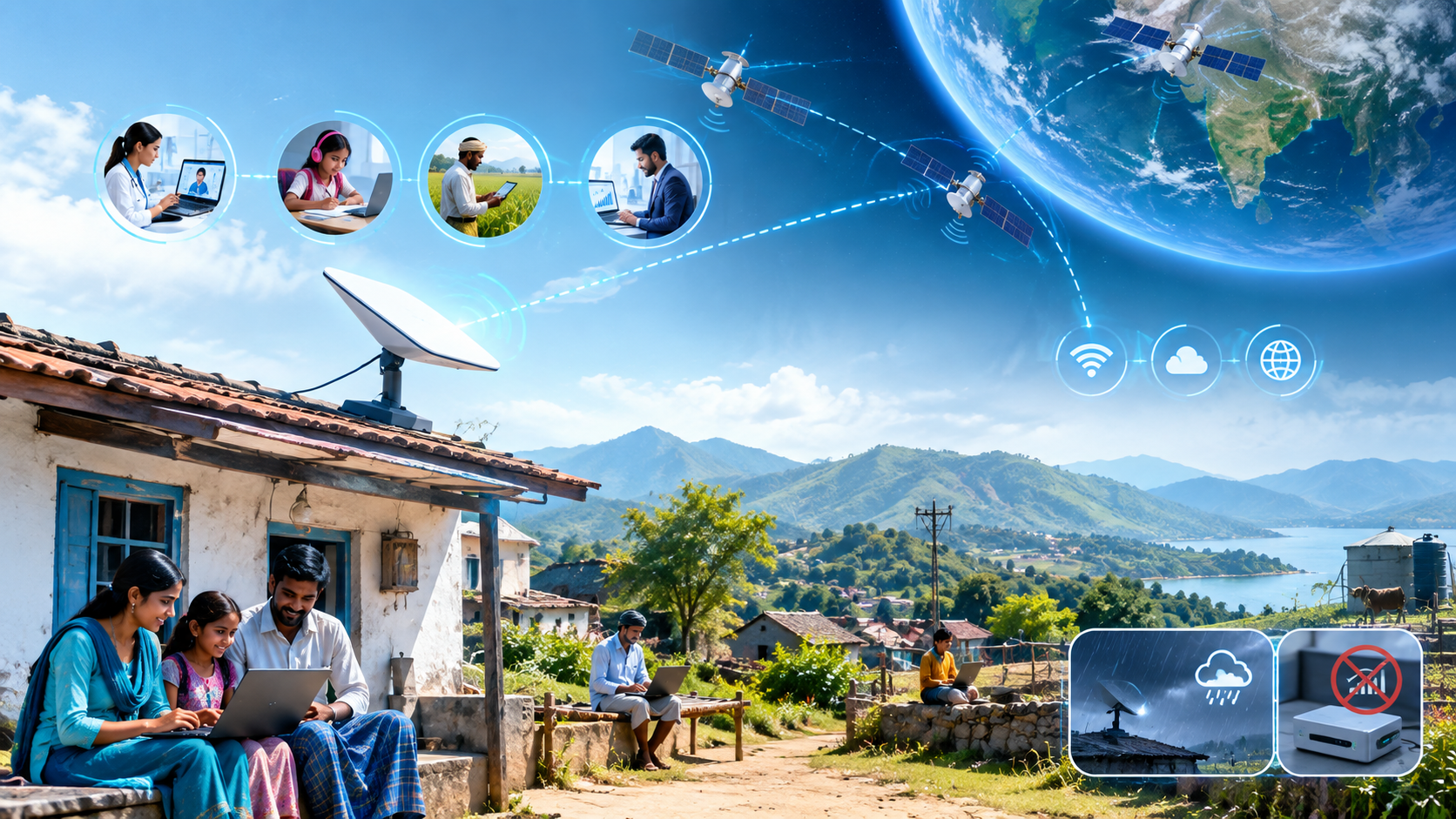
Yes, satellite internet could be valuable in parts of rural India where building conventional infrastructure is difficult. Mountain communities, remote islands, isolated farms, and some areas with limited connectivity may benefit if the service is approved, available, affordable, and reliable in those locations.
Better internet access can support online education, digital payments, communication with customers, remote work, access to information, and some healthcare services.
It may also provide another communication option during certain emergencies when ground infrastructure has been damaged. However, satellite internet is not a complete replacement for local mobile networks, fibre networks, electricity, or emergency communication systems.
The actual benefit will depend on equipment and subscription costs, suitable installation locations, service capacity, and whether local users can afford it.
Will Starlink Make Internet Cheaper in India?
It is too early to make a definite promise about prices. Greater competition can encourage providers to improve their services and offer more choices, but a new technology does not automatically lead to lower bills for every customer.
Satellite internet has different equipment and operating costs from many ground-based connections. Its final price in India will matter greatly when deciding whether it is suitable for households and businesses.
Until official local plans are announced, it is better to avoid claims that the service will definitely be cheaper or more expensive than every existing option.
Frequently Asked Questions
Why is Starlink delayed in India?
As of 9 October 2026, reports identify security compliance and spectrum assignment as outstanding requirements for a commercial launch. The government says the three licensed satellite operators are at a broadly similar regulatory stage.
Has Starlink received a licence in India?
Yes. Recent reporting confirms that Starlink has obtained a licence, but a licence alone does not complete all the requirements for a commercial launch.
What is the biggest disadvantage of Starlink in India?
The most important considerations include equipment and subscription affordability, a suitable view of the sky, electricity requirements, possible weather effects, and how its performance compares with existing broadband. Its exact Indian retail price and customer performance cannot yet be assessed from an operating residential service.
Will Starlink be useful in Indian villages?
It could be useful in villages and remote locations where reliable mobile or fibre broadband is unavailable. Its practical value will depend on official availability, cost, network performance, and local conditions.
Is Starlink completely blocked in India?
It is more accurate to say that commercial service has not launched because outstanding regulatory requirements remain. A claim that the service is being deliberately blocked by competitors has not been independently established by the public evidence cited in this article.
Official Sources and Further Reading
- Latest reporting on the Indian approval delay and government response
- Indian telecommunications rules, including satellite security requirements
- Official recommendations on spectrum assignment for satellite-based communication services
- Official consultation paper on satellite communication authorisation and spectrum assignment
Conclusion: Is Starlink the Right Choice for India?
Starlink could improve internet access for people living in remote and poorly connected parts of India. However, it is not automatically the best choice for every household or business.
Security compliance, spectrum assignment, equipment costs, installation requirements, weather, and local network conditions all matter. Existing fibre and mobile broadband may remain more practical where they already provide reliable and affordable service.
The current debate is also a reminder that competition and national security both matter. Providers should be able to compete fairly, while every operator must follow the same applicable laws and technical requirements.
For Indian users, the sensible approach is to wait for confirmed commercial availability and official local pricing, then compare the service with the alternatives available at their address.
At Make My Works, we believe that understanding both the benefits and limitations of technology helps people make smarter digital decisions.